Showing posts with label Review SAP. Show all posts

Role of SAP Functional

9:05 PM 3 Comments


What are the differences between a functional and business consultant?

The difference between Functional consultant and Business consultant are as follows: 1) A functional consultant is able to configure the system unlike business consultant. 2) Functional consultant know more about business process unlike Business consultant. 3) A business consultant will bring business process knowledge and provide it to functional consultant who in turn used this knowledge to configure the system.  4) Functional consultant has more configuration knowledge then Business consultant.          *-- Rocky


The responsibilities of a support consultant are:
- Primarily responsible for Handling tickets and application support to the end users
- When an issue comes diagnose, analyse and solve the issue
- Responsible for any enhancements
- Writing functional specs and interacting with Abapers to develop any user exits
- Training the end users and preparing end user training material                         
*-- Sistla 


For those who wished to know the role of a functional consultant.  Below is one view:
A functional consultant evaluates the demands in talking with the customer's representatives, transforms the essence into an abstract and algorithmic business model. Hence, he identifies the use cases and transforms them into logical and technical views. 
Then the main task starts: customizing the respective business area and making sure the system reacts in the manner according to the constraints of the requested use case. 
The consultant documents the settings and prepares proper guidelines that allow other consultants to do further changes or repairs with due efforts. 
The consultant takes care that proper training is given to the users and that the system is usable, performing appropriately and the business flow is complete and correct. 
During go live he assists the technical staff by testing the behaviour of the system. 
After go live he guarantees that the procedures remain usable and consistent in real live situation and proposes enhancements. 
The main duty of a consultant is to transfer external know-how to the client. It is not manpower that counts but intelligence, understanding of processes, a feeling for defects and general a common sense.  


Role of a Functional Consultant in an End To End Implementation
When you talk about the role of a Functional consultant in an end to end implementation, I think it won't be possible for me or anybody to define everything but I will try to summarize it:
1. Functional consultant is expected to generate knowledge about the current business process, design current business flows, study current business processes and its complication, in all we can say getting through with current business setup. Flow diagrams and DFD are prepared, most of the time in Vision format, all this forms the part of AS IS document.
2. Everything configured has to be documented as per their categories in the form of predefined templates, these have to be then approved by the team leads or who ever the consultant is reporting to.
3. Mapping and GAP analysis is done for each module, I have seen people defining integration after mapping, gap analysis and configuration is done, but as per my experience in implementation, it is a simultaneous process.
4. Before starting configuring  future business processes in SAP, the DFD/ERD are prepared, this documentation is called TO BE, which can be also said as the result of mapping and gap analysis.
5. Sometimes Functional consultants are also expected to prepare test scripts for testing the configured scenarios.
6. End user manual and user training is also expected from F.Consultants.
The project normally starts off  with a Kick off meeting in which the team size, team members, reporting system, responsibilities, duties, methodology, dates and schedules, working hours which have been predicted are formally defined.
ASAP, it won't be possible for me to explain it here, but all I can tell you about it is that it is SAP standard implementation methodology, which SAP prescribes but is not mandatory for any company to follow, such as IBM follow some blue Methodology, some companies follow typical SDLC steps, ASAP stands for Accelerated SAP, you can find all the steps on SAP site, through google, reading it from there won't give you a great knowledge about ASAP but will obviously get you to know the definitions of various term. 
Tips by: Pascal, Nitin, Sushil Pandey

Source : http://www.erpgreat.com/general/role-of-a-sap-functional-consultant.htm


Explain ‘ASAP Roadmap’ Phases.

7:59 PM Add Comment
Explain ‘ASAP Roadmap’ Phases.


  • Project preparation : is the first and initial phase of the ASAP roadmap where you are just starting the project. You will perform activities such as preparation of the initial scope, high-level timelines and plans, project charters, identification of project team members, project kick-off, etc.
  • Business blueprint : is the second phase in the implementation where you will try, identify, and document business requirements and goals to prepare the foundation for future stages of the project. Ideally, you will organize ‘business requirement gathering’ workshops with the various business/functional users of the company, lead them through the discussion with structured business functionality questionnaires, understand their existing business processes, and identify and document their requirements in the wake of this new implementation. A ‘sign-off’ at the end of the phase ensures an agreement to move forward outlining the scope of the project. It is understood that whatever is explicitly stated in the business blueprint document is the only scope; no implied scope will be considered for system configuration in the next phase.
  • Realization : is the third phase where the implementing team breaks down the business processes identified in the second phase and configures the SAP settings. Initially, you will do a Baseline Configuration, test the system functionality and if necessary make changes to the baseline configuration, and close the phase with Final Configuration, signalling that all the business processes have been captured and configured in the system.
  • Final Preparation : is the penultimate phase in the project. This phase also serves to resolve all crucial open issues. A ‘go-live check’ is also conducted to analyze whether the system has been properly configured. This phase is marked by the following activities: 
    • End-to-testing of the configured system (User Acceptance Test—UAT)
    • Training of the end users (Usually follows the concept ‘Train-the-Trainer’)
    • System management activities (creation of users, user profiles, allocation of roles to profiles, etc.)
    • Cut-over (data migration activities) 
An ‘internal help desk’ should be staffed and supported mainly by employees of the enterprise. Setting up a   help desk involves, among other things, installing office and technical equipment and defining OSS users. Problems that cannot be solved by this internal help desk are forwarded to SAP via the SAPNet/OSS system. On successful completion of this phase, you are ready to run your business in your production system.
  • Go-Live and Support : is the final and fifth phase of the project where the configured system is declared ‘live’ for day-to-day business use. Users make productive (live) business transactions in the system and all the issues cropping up in the wake of going live are supported and resolved by a support team immediately.


‘Industry Solutions’ (IS) are Available from SAP

7:24 PM Add Comment
‘Industry Solutions’ (IS) are Available from SAP


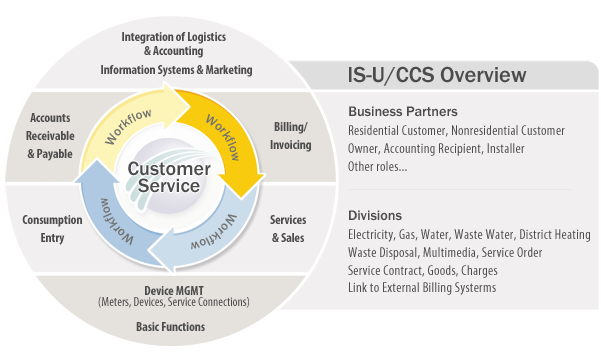
There are 22 Industry Solutions available from SAP. They are:

􀂃 SAP for Aerospace and Defense
􀂃 SAP for Automotive
􀂃 SAP for Banking
􀂃 SAP for Consumer Products
􀂃 SAP Contract Accounts Receivable and Payable
􀂃 SAP for Defense and Security
􀂃 SAP for Engineering, Construction and Operations
􀂃 SAP for Financial Service Providers
􀂃 SAP for Healthcare
􀂃 SAP for Higher Education and Research
􀂃 SAP for High Tech
􀂃 SAP for Insurance
􀂃 SAP for Media
􀂃 SAP for Mill Products
􀂃 SAP for Mining
􀂃 SAP for Oil and Gas
􀂃 SAP for Professional Services
􀂃 SAP for Public Sectors
􀂃 SAP for Retail
􀂃 SAP for Telecommunications
􀂃 SAP for Utilities
􀂃 SAP for Wholesale Distribution

Review SAP

7:09 PM Add Comment
Review SAP

What is SAP?
‘SAP’ is an acronym for ‘Systeme, Anwendungen, Produkte der Dataenverarbeitung,’ in German, meaning ‘Systems, Applications, and Products in Data Processing.’ Founded in 1972, SAP — with its headquarters in Walldorf, Germany—is the global market leader in collaborative, interenterprise business solutions (i.e., business software). SAP employs close to 40,000 employees worldwide, with more than 100,000 installations in about 40,000 companies in 120 countries. More than 12 million people use SAP on a daily basis. There are more than 20 industry-specific ‘Industry Solutions,’ known commonly as ‘IS’ (IS-Oil, IS-Retail, IS-Bank, etc.).

History of SAP 


  • SAP was founded by five former IBM employees, in 1972, to develop a standard business application software, with the goal of processing business information in real-    time.The company, SAP GmbH, was started in Mannheim, Germany.
  • During 1973, the company released its first financial accounting software, ‘R1’ (the letter ‘R’ stands for ‘Real-Time Processing).’
  • In the late 1970s, SAP ‘R/2’ was released with IBM’s database and a dialogue-oriented business application.
  • R/2 was further stabilized during the early 1980s and the company came out with a version capable of processing business transactions in several languages and currencies to meet the needs of its international clientele.
  • SAP GmbH became SAP AG in 1988. Later on, the company established subsidiaries in  countries such as the United States, Sweden, Denmark, and Italy.
  • The 1990s saw the introduction of SAP ‘R/3,’ with client-server architecture and GUI, which ran on almost any database, and on most operating systems. SAP R/3 heralded a new era in enterprise computing, moving from a ‘main frame’ to a 3-tier architecture (Database->Application->User interface), which became the new industry standard.
  • By 1996, the company had more than 9,000 installations worldwide. By the end of the 1990s, SAP had introduced the e-commerce enabled mySAP suite of products for leveraging ever-expanding web technology.
  • SAP began the twenty-first century with the Enterprise Portal and role-based access to business information.
  • SAP continues to evolve and innovate, bringing cutting-edge technologies to business information processing. SAP has already introduced SAP NetWeaver, which is based on Enterprise Services Architecture (ESS) with application integration across diverse platforms for providing one-stop end-to-end business processing. With NetWeaver, companies can now integrate people, information, and processes.